It is not an exaggeration to state that Topeng Pajegan is the most demanding mask performance for an actor to stage. The distinguishing feature of Topeng Pajegan is that it is a monodrama in which a single dancer tells a story by portraying a succession of masked characters. With the help of a few simple theatrical conventions, the solo performer of Topeng Pajegan is able to tell a complicated and engrossing story single-handedly.
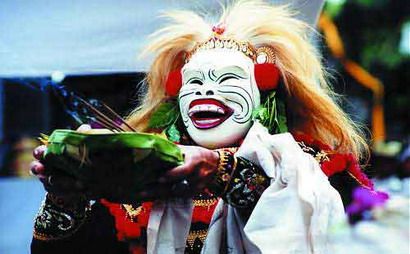
Topeng Pajegan is not an entirely secular performance which is devoted solely for the entertainment of the audience but it contains a ritual portion similar to the sacred dances which are performed only in the inner courtyard of the temple. The ritual portion is not integrated with the story performed by the dancer but is reserved for the end. In the sense that the ritual portion is the most important one and the secular portion of the performance is a prologue to ritual portion. At the end regardless of what story has been presented, a strange white-faced, buck-toothed, smiling character with long, wild hair comes to the stage. His name is Sidakarya which means ‘he who succeed in all task’. Only when he wears this mask, the dancer serves a specifically priestly function to pray for the success of a ceremony.
The stories presented in Topeng Pajegan are taken from chronicles of Balinese history which mainly deals with semi-legendary feats of Hindu-Balinese kings, their ministers, and their princes. The dancer composes his own plays from the palm leaves manuscript source by giving much consideration on the traditional rules and procedures in mask performance. The story presented on a particular occasion is chosen by the dancer in accordance with the needs and desires of the sponsors.
The performance of Topeng Pajegan requires a small space, oval area on the bare earth, some 2.5 by 3.5 meters in size. The dancer places his basket of masks on a table in front of the Gamelan which will accompany him. During the performance his masks are spread out on this table. His performance is oriented toward the shrines where the gods reside.
Language which is used in Topeng Pajegan is varied, range from ancient Sanskrit to vernacular low Balinese based on the characters. The Sanskrit is used only in prayer, chanted by the Sidakarya. Kawi language is used by the King and high-ranked characters. The Penasar (clown or retainer) use High Balinese when addressing their master and Low Balinese when addressing low ranking people.
The performance of Topeng Pajegan usually begins with the presentation of introductory character study (pengelembar) in which three characters which have no connection with the story appear successively to give a hint to the audience on what they will see and to introduce various moods of the characters. This section gives an opportunity to the dancer to show his dancing skill, this section is a passage of puredance.
After the pengelembar has been presented, the dancer begins to relate the particulars of the chosen story. This is invarably begun with penasar. In Topeng Pajegan the penasar can be in two different types, either the penasar kelihan, or ‘older brother’; or penasar cenikan, or ‘younger brother’. The former may also be known by his proper name, Punta, and the younger by Wijil. The older brother, Punta, establishes the theme of the story to follow. He may also embellish the exposition of the theme with jokes that are relevant to the story and its theme.
After the penasar finishes his role, the dancer changes the mask of penasar with the mask of King or Dalem. The mask of the king is of refined type and cover full face, which means the dancer must perform in silence when portraying the character. It is always white or very light green. The face represented on the mask is an ideal portrait of a king. The dance of the king must demonstrate the ideal qualities of Hindu-Balinese kingship: dignity, grace, and refinement.
After the king character finishes his solo, the dancer appears with penasar mask. He may improve audience’s understanding of the story or do a little clowning as well. The penasar, at this point, must prepare for the entrance of the next essential character, the strong, good Patih (minister), whose function always to carry out the will of the refined King.
The dancer now changes to patih mask. The patih mask is brown with large eyes and fierce moustache. His movements are energetic and forceful, yet always controlled and dignified. The patih performs his own introductory solo, demonstrating the qualities of his character. After the patih finishes his introductory solo, he gestures to his (invisible) penasar to make ready for a departure on the planned expedition, the nature of which depend on the particular tale represented.
After the patih depart from the stage the dancer changes to comic character masks. This series of comic masks perhaps half a dozen in all, are impersonated by the dancer, a real test of his virtuosity. The characters belong to lower caste and are very eccentric. They often represent oppressed villagers who need help of the patih to rescue them from the trouble; often they are portraying to have physical defects and handicaps. Some characters have buck teeth, other have cleft palates, still others have long noses or no noses at all; some represented as being deaf or blind, or having speech impediment. After the last of comic characters finishes his part, the dancer change to the penasar mask and appears on the stage to explain how the patih helps the oppressed villagers and explains the story is over, the trouble maker has been defeated and that it is now time for a celebration. The narrative portion of the performance is ended and it is time for ritual to begin.
 babadbali.com
The dancer puts on the Sidakarya mask, along with a wig of long, wild hair. The dancer seizes the offering that has been prepared beforehand, dances with it over to the shrines, shouting and laughing and praying in Sanskrit over the offering. Once he has presented the offering to the gods, he turns his back and showers the audience with handfuls of specially blessed Chinese coins kept with the offering. The spectators scramble to pick up the lucky money. He also sprinkles holy water and flings rice around the stage to bless the audience. Suddenly, the Sidakarya lunges into the audience and snatches up one of the small children who make up large part of the audience.
All of the children in the audience, who have been waiting for this moment, rush here and there, shrieking with fright as the Sidakarya approaches, but he always manages to catch one. He carries the struggling child over to the shrine and holds him up to the gods before giving him a small present among the offerings there. The child is then put down and disappears into the crowd with his trophy. The performance is over; the dancer puts away his masks in their basket after presenting a small offering to the god Wisnumurti, patron of the dance.


